Skip to content

La Cornue Oven Door Sticking or Not Sealing What to Check

Why a La Cornue oven door may stick or leak heat, and the safe checks to make before calling service.

At a glance

Article overview

La Cornue Oven Door Sticking or Not Sealing: What to Check
Quick answer

Why a La Cornue oven door may stick or leak heat, and the safe checks to make before calling service.

A La Cornue oven door that sticks or does not seal is usually a matter of the door seal, the hinge alignment or the range not sitting level, and not a lock left engaged. The Chateau and CornuFe manuals describe no self-clean cycle and no cleaning lock, so look at the seal and the fit before anything else. If the door still binds or heat is escaping around it, book service instead of forcing it.

Guide

What the door is meant to do

Traditional Chateau cooking guidance describes hearth-shaped ovens with a cast-aluminum door seal that keeps heat and humidity balanced. The convection in those ovens is natural rather than fan-driven. So the door is not only a way in; it is part of how the oven holds its temperature. When it stops closing evenly, the oven can cook unevenly, take longer to recover, or leave the front of the range hotter than usual.

Because the manuals contain no self-clean cycle, no door lock is waiting for a program to finish. A door that resists opening therefore calls for a different explanation than it would on an oven with a cleaning lock, and the cause is mechanical until shown otherwise.

Guide

What are the signs of a sticking or leaking oven door?

A door that sticks tends to show itself at the edges. You may feel it catch on one side, see a gap along the top corner, or notice that it swings closed on its own, or fails to. A door that does not seal tends to show up in results: pale cooking on one side, steam or warm air along the edge, or discoloration where heat has escaped. The CornuFe guide notes that steam at the rear grille and a puff of steam when you open the door are normal with moist foods, so a little steam alone is not a fault.

Compare what you see to how the door behaved when the range was new. A change over time points toward wear or a shifted hinge. A change right after the range was moved or cleaned points toward alignment, a seal that was pushed out of place, or food residue at the edge.

Guide

What the owner can safely check

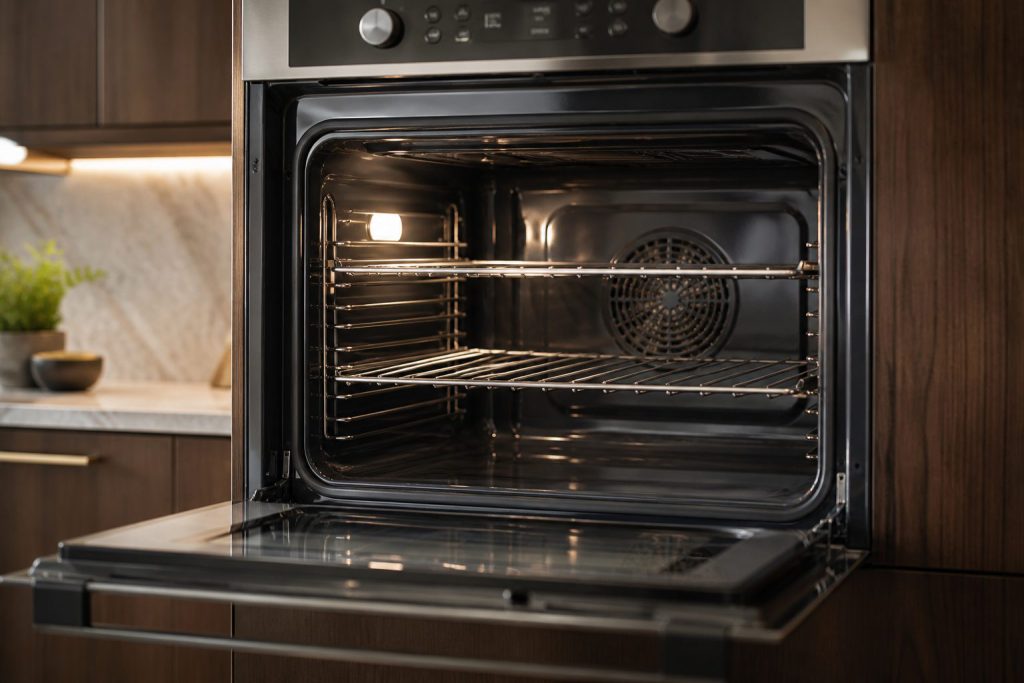
With the oven cool and the range not in use, look at the seal around the opening and the door. The manual’s own troubleshooting list for uneven cooking includes checking that the door seal is undamaged. Look for tears, flattened sections or baked-on grease that keeps the door from closing fully. Clean the surrounding enamel with warm, mild soapy water on a microfiber cloth, and dry it promptly, spraying nothing directly onto the enamel.

Next, check that the range is level. The CornuFe guide suggests a dish-of-water test: set a shallow dish of water on a rack and see whether the water pools to one side. A range that leans can make a door close unevenly. The same guide says the bottom door hinge can be adjusted if the door is misaligned, so read that section of your manual before touching anything, and do not remove panels or disassemble the hinge.

Symptom What it can point to What you can check
Door catches on one side Hinge alignment or a leaning range Level test; manual section on hinge adjustment
Gap along an edge Door out of square or a displaced seal Visual check of the seal when the oven is cool
Food browns unevenly Heat escaping or a worn seal Seal condition; turn large items; rack position
Warm air along the edge Seal not meeting the frame Grease or debris along the contact line
Steam when opening Normal with moist foods Nothing, unless it persists with dry foods
Hot knobs or fascia Door left open, or heat escaping Keep the door open only as long as needed
Guide

What these checks do and do not tell you

Treat each check as one piece of evidence. Write down what you saw, when it started and whether it changes between a cold oven and a fully heated one, because a seal that looks fine at room temperature can behave differently once the metal has expanded.

A clean, intact seal and a level range rule out the simplest causes, but they do not prove the hinge or door is healthy. A door can look fine and still be slightly out of line. Equally, finding a bit of baked-on grease does not mean the grease was the whole problem; clean it, then watch whether the symptom changes over a bake or two.

Never use abrasive cleaners such as scouring powder on the enamel. The cleaning guide warns they may compromise the enamel seal, which can make the original problem worse.

Get help

When to stop and call

The point of these checks is to narrow the question, not to repair the door.

Stop if the door will not close at all, if it will not open and the oven is cold, if the seal is torn, or if the front of the range is clearly hotter than normal in use. The manuals say that an excessively hot fascia can point to a cooling-fan problem, which is separate from the door and needs a qualified technician. Do not force a stuck door, pry at the hinge or run the oven with the door held shut. Note the model label, how the door behaves at each position and when the change began.

Guide

Frequently asked questions

Does my La Cornue oven lock the door during cleaning?

The Chateau and CornuFe manuals describe manual oven cleaning and no self-clean lock. If your door resists opening, treat it as a mechanical or fit issue and check your own manual.

Can I adjust the door hinge myself?

The CornuFe guide mentions that the bottom hinge can be adjusted for a misaligned door. Follow only what your manual shows, and call service if it calls for tools or panel removal.

Is steam at the door a sign of a bad seal?

Not by itself. Steam at the rear grille and a puff when you open the door are described as normal with high-moisture foods.

Can a range that is not level affect the door?

Yes, it can affect how the door sits and how evenly the oven cooks. The dish-of-water test in the manual is a simple way to check.

Need help now? Visit our services page or contact us.

Official manuals and support notes are available on La Cornue Support.

Get started

Need help with a La Cornue appliance?

Book a La Cornue service visit for a clear estimate and approval before any repair. Specialist technicians, clear diagnostics, and workmanship coverage on completed repairs.

FAQ

Frequently asked questions

Keep reading

Similar articles

View all articles

Get started

Ready to restore your La Cornue appliance?

Book a repair online or call us — clear estimates, approval before any work, and a workmanship warranty on completed repairs.

Book a repair

Tell us what’s wrong — we’ll take it from there

Share a few details and we’ll confirm an appointment. Prefer to talk? Call us and we’ll help right away.

Hours Mon–Sat: 8:00 AM – 7:00 PM
Service area Serving Miami, New York, Houston, Los Angeles and San Diego metro areas.
Response time Appointment timing depends on location, route capacity, appliance type, and parts needs.
Call Book a Repair